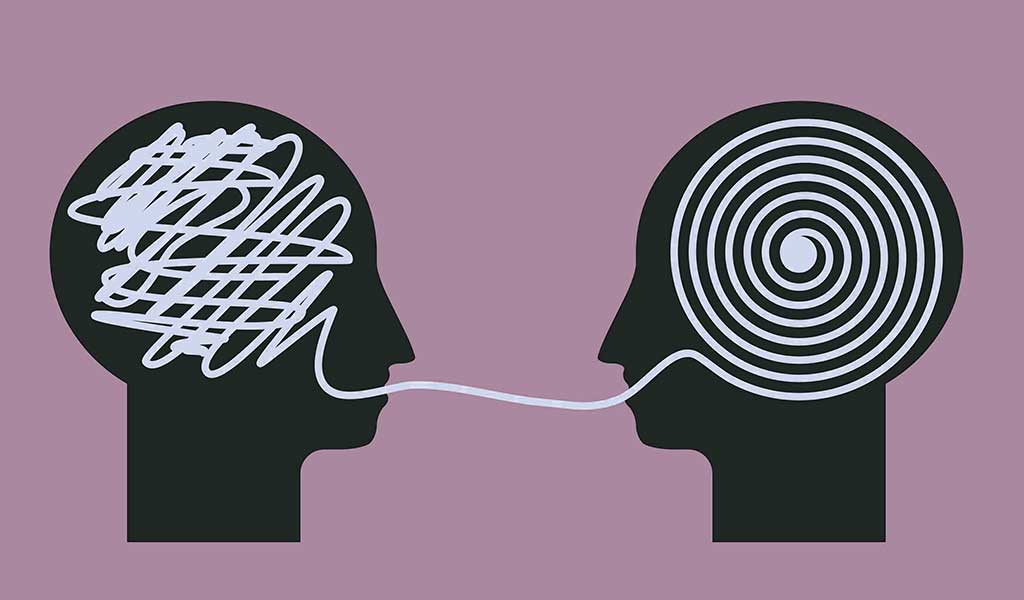
Our perceptions determine how we see the world and our response to events, people, etc. Our perceptions can change over time, depending on our circumstances or our own level of growth; are we healing ourselves or running away from anything that may feel too painful or threatens to shatter our preconceived ideas?
Our world is moldable, meaning most of what we perceive is determined by our way of looking at things, this can be a problem when we fall under the idea that our perception is the only perception that should be considered valid, right, or accepted as the ultimate truth.
Gnostics and Buddhists have always taught about the importance of understanding“there are many paths which lead to illumination”; what works for one, may not work for the evolution of another. They warn us about falling prey to dogma, and as such they always promote introspection; however, they highlight our need to understand that at the end of the day all we have is theories–it matters not if they are ancient teachings, modern science, etc.–when it comes to the complexity of life, its mechanism and the complexity of our own body and mind, there are no absolutes; what may seem like an absolute today, maybe something which later on will be discarded, proven to be false or no longer has value.
Gnostics and Buddhists remind us of Maya (the false illusion) and how what we perceive as reality is but a fragment of reality; as such it is not absolute. Although there are certain primordial rules that determine certain patterns within our universe and life, most of life and what we experience is always morphing, changing, and adjusting. It would be naïve, then, to believe that we, as human beings, who are part of the same mechanisms, have found the absolute answer to life, for not even the sages claimed to have done so.
Gnosticism and Buddhism clearly embrace philosophy (the art and discipline of introspection) as the cornerstone of their philosophies, (people are the ones who many times try to turn these branches of learning into a dogma or cult instead of seeing it for what they are, a branch of knowledge which if distorted and labeled as something absolute, loses all its value). These philosophies focus on how, at times our senses can betray us, and errors of perception can cause unnecessary suffering or can turn us into tyrants. Often these perceptions are born out of our inability to have the discipline to accept that there is more to this world than meets the eye, more than just what we have been taught.
These sufferings can also arise from confusing the teachings of non-attachment with zero attachment to anything or anyone, as well as confusing transcending the false ego with the nihilation of a healthy ego; at their roots, both of these philosophies teach us that in order to survive in this world, to be a more congruent person, we need an ego–our ego is our personality and only personality can experience life as it is; for although we are spirit, spirit has no need to experience life in a 3D reality.
Buddhism and Gnosticism say these false perceptions are what cause people to walk the wrong path, for there are many ways in which the false ego can trap someone who does not practice introspection; even then, one can be fooled– for again, we only see but a fragment of life’s reality. According to them, some of the key errors we experience in perception are as follows:
1. We see permanence in what is mutable.- One of the greatest differences between these teachings and our current state, especially in the West, is our inability to understand life is always expanding, changing, morphing– it is mutable. We tend to want what is “permanent” on what is mutable. The idea of what is stable and eternal is very attractive, yet it is cause much suffering for nothing remains stagnant; only our perception can remain stagnant and only because we choose to negatively exercise our power and remain so, but life itself is ever-changing.
The paradox to this can be found in our current way of living, where most things and even people are discardable, yet we want “permanent.” In our current society, everything is temporary, disposable, and can be left at a minute’s notice. People use and treat things and even people the same way we treat our undergarments; changing them constantly. Of course, we justify our ever-changing attitudes within the frameworks of strong axes, such as consumption, productivity, false happiness, and the false idea of success.
Seeing permanence in what is mutable and not taking the time to understand the happy midpoint (balance) is what causes so much suffering. The above philosophies teach us that lack of permanence is an essential reality and is present in everything. For example, the idea of success is open to perception; what may be success for one may not be for another. One path of healing and growth may not work for another. A soldier who battled for one country does not make the soldier who battled for another bad; because they each had a perception and to each, their perception was valid and good–the problem arises when we believe ourselves to be the ones who know exactly what is truth; but truth is subjective to one’s perceptions or how such truths present themselves. We can assume there is an ultimate truth to life and its secrets; although ever-changing it would not be naïve to assume it has a system; however, if we can’t even govern ourselves nor have figured out the inner mechanism of our own subconscious, what makes us so arrogant as to think, we are the ones who hold the ultimate truth?–that is ignorance talking; for if one has not mastered oneself, how could we possible assume we have the ability to discover much less recognize the “Ultimate Truth”?–we can feel it but it does not mean we know it, and let’s not forget our feelings can be at times obscured by our own skewed perceptions. Here, the saying by Socrates, “The more I learn, the less I know,“ is definitely a more coherent and honest perspective.
Everything is in motion, and rejecting that truth leads to unhealthy attachments (which we all in one way or another have experienced) and stagnant attitudes; this of course will lead to suffering and victimization, for in seeking to destroy the ego (which helps us differentiate one thing from another) we fall pray to our false ego.
2. Finding pleasure in suffering.- Both of these philosophies teach about the difference between following dogmas – which teach its disciples about the paradox of a loving God who demands them to live within limited ideas, which only lead to unnecessary suffering or to living in hypocrisy – vs. the embracing of the shadow.
From the outside, both deal with suffering; however, one is suffering with no growth, while the other is temporary moments of pain that lead to growth and healing. Not understanding the difference is what causes, on the one hand, rigid attitudes, while on the other, the desire to “run away” prevails. In other words, people are willing to suffer in exchange for being considered “good” or in exchange for some after-life reward or the false reputation of being “holy”–but they are not willing to experience moments of pain (facing shadow) in order to remove the shackles, to start healing and start owning and exercising their own power.
To the above philosophies, by living embracing pain which leads nowhere and running away from pain; which helps you transcend and discover your inner gifts; is why we experience the duality that is damaging, as well as finding ourselves living within a paradox that leads to only more suffering–our attempt to ran away from our own contradictions is what contributes to us choosing masks over self.
3. Finding “beauty” only on what is superficial.- To Gnosticism and Buddhism, beauty is discovered in each reality’s particularity and its understanding. This can only be achieved through contemplation, an action that allows you to penetrate the essence of something or someone and to appreciate it in all its fullness. This type of beauty is all around us but it is rare to access because we are too busy running away from life, or when it comes to people, we are too busy putting up walls and/or not care to know the person behind the superficial mask. The type of beauty Gnostics and Buddhists speak of can enrich our lives because it can help us discover more about our own selves, discovering the wonder of each being and thing.
As strange as this may sound, according to the above philosophies, the superficial often passes itself as beautiful when errors of perception are present or when people live in a society so wounded that it is not willing to face itself but will do anything to run away. The mistake is to see beauty from the outside; from a peripheral look that does not go into the essence but stays in the form. In this way, anything superficial ends up being attractive in the eyes of someone unsuspecting, and anything or anyone that requires us to take off the masks becomes something or someone to run away from.
To Gnosticism, the superficial or abject is what is ruinous and despicable. In today’s world, many things and people take beautiful, righteous or benevolent forms, covering up the vileness that inhabits them. For example, A fur coat at the cost of an endangered animal, a so-called expensive diamond at the expense of the sweat of underpaid, overworked, and abused people. A person who always seems happy and content yet hides destructive darkness, etc.
According to these philosophies, errors of perception arise from enslaved minds–willful slavery. Such slavery increases as the dependence of the mind upon the false ego becomes greater. Although the superficial may seem a quick “reward” for not having to experience the pain of shuttering our preconceived ideas, the whole time it demands a high price–that price is your authenticity, your imperfect but beautiful self.
Introspection, accepting ourselves with our light and darkness, recognizing both as equally beautiful parts of us; and expressing ourselves as the imperfect, wounded beings that we are, is what makes contemplation a gift and should be part of our everyday life–the work isn’t easy nor fast but the reward is permanent, allowing us an understanding beyond the cognitive. Living by the rhythm of our heart and expressing ourselves as we are is what, according to Buddhists and Gnostics, will lead to enlightenment, for there lies coherency of mind, body, soul, and ether–again, the choice is an individual one.
We can talk about freedom and self, but until we are willing to be responsible for ourselves instead of waiting for saviors, we will not experience freedom.


 Eiros
Eiros 
Good stuff! Keep it up!
LikeLiked by 1 person
Thank you kindly 😊🙏
LikeLike