
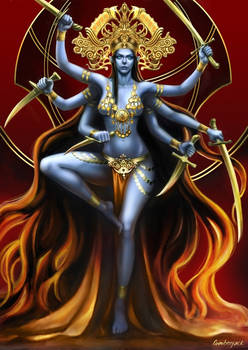
Today, I would like to focus on the Goddess Kali, for she is the perfect archetype to help us understand our own shadow, darkness, pain, genius, and pleasure. I believe anyone who is in touch with their shadow and knows what it is to struggle yet is able to recognize the tremendous power locked inside, will be able to relate to the beautiful meaning this Goddess brings with her.
Kali is one of the main Goddesses, often called the consort and most beloved of the male God Shiva. Kali is recognized as the primordial Goddess; like Sophia to the Gnostics, Kali is revered as the beginning (benevolent, loving, fructuous) and the end (pure chaotic creative energy). She is the ultimate reality from which all things are born…the source of being, of creating and destruction.
In the tales that explain more the archetypes of the primordial forces (male and female energy), Shiva loves Kali despite her chaos and ferocity, for he sees the beauty past the armor and darkness (pain) in her. Only Shiva, the strongest and most important of Gods referring to masculine energy, can match Kali–for, like her, he is love and benevolence but also a fearless and mighty warrior.
It is said that when Kali is “unchained”, she becomes wild and unstoppable, and only Shiva can get through to her. This is because, at those times, she is a transformed version of Shakti– the dark side of the moon–but no matter which side, she always remains Shiva’s beloved. Kali only listens to Shiva because he is the only one able to match her love and ferocity. Shiva’s methods to get through to his beloved when she is in Kali vary, from challenging her to the wild tandava dance and outdoing her–not from ego, but desire– to methods such as appearing as a crying baby (thereby appealing to her maternal instincts) –the iconography often depicts Kali dancing on Shiva’s fallen body. There are references to them dancing together, in a state of frenzy and ecstasy.
Just like Gnostics know, understanding both of Sophia’s natures is the only path to obtaining wisdom. To Tantrics, understanding Kali is of utmost importance. Shiva’s involvement with Tantra and Kali’s dark nature has led to her becoming a vital figure spiritually, psychologically, and for Tantra (body).
For tantric, facing her curse by meeting, exploring, and healing our own terrors, traumas, darkness, and pain is essential. It is imperative to dive into our terror of death to truly understand life’s gifts. As such, instead of seeing her as someone to be afraid of, they chose the path of Shiva and arranged to accept the blessings of her beautiful and consolidated maternal aspect. For them, there is no greater endeavor than to beat illusion, recognizing life is made of two sides: death cannot exist without life. Equally, life cannot exist without death–light, without the meeting and embracing of our own darkness, is but an ember of the powerful fire we carry inside. Kali’s role is valued, for she is the chaos that needs to be faced to bring out … wisdom.
Kali today is perhaps the goddess best known and used within experiences and rituals, especially regarding the Sacred Feminine. For many, Kali symbolizes the pure power of liberation from repression and destruction of all that is bad and the oppression of the old paradigms. Kali represents the embracing of our darkness in order to reconstruct or rebirth a new someone–a consciously chosen someone–without delusions or superficial light.
Kali is the Goddess of transformation. When we honor her, we also honor all the changes in our life, the universe, and life itself. It shows us the cycles found in everything – in nature, seasons, our relationships, our moods… remembering that everything must always keep changing to remain vital.
Kali teaches that pain, sadness, decay, death, and destruction cannot be overcome by denying, running, or simply trying to rationalize them–the so-called negative emotions, trauma, mistakes, defects, and more are inevitable parts of life, and denying them is useless. To realize the fullness of our being and realize our potential, we must accept these parts of us do exist. Kali’s gift is freedom, the freedom that is only obtained after the confrontation or acceptance of one’s own darkness…it doesn’t mean one is liberated or healed overnight; it means one is not lying to oneself about one’s true nature.
Kali’s essence is this fusion of contradictions, a mysticism with which no other deity has been endorsed; she is perhaps the most mysterious deity. While she makes gestures (mudrás) that represent the absence of fear and benevolence, she also has a terrifying appearance. She can go from gentle to warrior, to even death itself– when submerged in her own chaos, feeding on the blood of those she kills–this part of her archetype, of course, can be cause of great alarm to anyone who doesn’t understand her true nature. Still, to Tantrics, all this means is that Kali knows when to use her sword without remorse, slaying the enemies that seek to destroy her. In other words, as an archetype, it shows us that there are parts of our shadow we need to embrace to find peace; however, this doesn’t mean one becomes subservient, for the desire to be pleasing or peaceful all the time can contribute tremendously to the rise of tyrants and destructive behavior from others to the individual or from groups of power to those they see as “below” (the people)–Kali, then says “NO”, this will be as far as you go–for sometimes to bring peace, one also needs to know how to bring and use the sword…such is the duality of our world; we can try to deny this fact, but doing so, doesn’t make it any less real.
In most of her images, Kali is stepping on Shiva, who embodies the indestructible soil of consciousness. Contrary to what most believe, Gnosticism, Hinduism, Tantra, and Original Buddhism see the feminine principle as the active principle, the dynamic manifestation of consciousness, while the male principle (Shiva) is the passive, immutable aspect. The energy of action and of transformation is female energy. Kali, steps on the conscious to demonstrate the tremendous power of the subconscious when not met. Once met, this power is transformed into pure power of transmutation or transformation–from Kali to Shakti…the loving side–but both are aspects of the same being. The Kundalini is the Shakti energy–energy from our deepest parts (the subconscious), consciously elevating itself through our sacred channels; once it reaches the crown, illumination can take place–in other words the unification of Kali and Shakti, give birth to our inner light and fire.
Shiva without Shakti is emptiness, for consciousness is expressed through its various manifestations. And Shakti without Shiva would be a corpse. For a body without a mind does not survive, neither can light’s existence be appreciated without darkness and vice versa–saint and sinner, make up the whole of a being who is no longer chained to delusions of sanctity or grandeur, nor is he punishing himself for his own darkness, but uses it to ignite the fire within…a process which cannot take place by simply holding a superficial lantern.
There is no need to mentally and physically castrate oneself to be worthy or holy…. on the contrary, our worthiness is exposed when we dare face our nature, understand it, and use it to serve our unique purpose…not that of an external belief. The union of the subconscious and conscious opens the path for our internal cool fire to wake up, to fuel us with passion and purpose, helping us walk through every “dark night of the soul” with less fear and more clarity and resolve. The union of Kali and Shiva symbolizes the non-dual nature of Reality. The fusion of what seems contrary–this process cannot be achieved by trying to understand oneself or life from a unilateral perspective alone.
Kali is the aspect of Shakti that destroys what has been created by the conscious and its limited vision and false veil to reveal the eternal nature of things, to show us life as is, not as we would like to believe it is. Kali forces us to awaken, to become our own warriors instead of waiting for external power to do the healing or show us the way–for all knowledge is already embedded within the labyrinth of our subconscious waters…we hold the map. Still, we have to be willing to find it and navigate it. A tree only rises when the seed explodes and is destroyed, this means the darker the place, the brighter the light that will illuminate it.
It destroys to recreate and helps us understand our pain so that joy is better revealed and enjoyed. Kali is the power of our shadow lying quietly in our subconscious but very much in control, removing the obstacles that prevent us from perceiving our true nature. Once we are done with each journey, we rise less confused and more empowered…a power not given to us as some merit, but rather, we reclaim from within, what has always been our birth ride.
So, as Nietzsche taught… face the abyss of yourself, or as Carl Jung said…dive into the abyss of your own chaos, for it is better to be someone who others don’t understand than to be one whom others easily accept but can’t recognize.
Kali may be seen as terrible for destroying what we cling to, but she is also compassionate, for freeing us from the illusion. She is the greatest representation that there is no transformation without pain, there is no rebirth without death.


 Eiros
Eiros 