
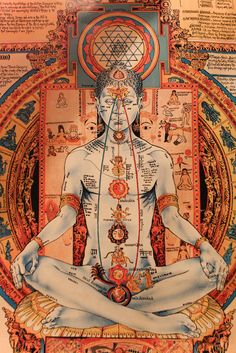
This article was put together after a recent read on Kundalini yoga, and the realization of how misunderstood the actual practice is. This piece is based on old textbooks as well as the summarizations of those more experienced in Ancient Traditional Tantra than me…
Kundalini Yoga as a term has become quite popular in recent years, but what most fail to realize is that what most people understand as Kunalini Yoga was started by a person called Yogi Bhajan who’s no longer alive and is actually a new thing from the 20th century. A scholar named Philip Deslippe wrote about this in detail in an article called “From Maharaj to Mahan Tantric: The Construction of Yogi Bhajan’s Kundalini Yoga.” Basically, Yogi Bhajan made up most of the stuff he taught as “Kundalini Yoga,” instead of inheriting it from somewhere else. So, the Kundalini Yoga you see in Western yoga classes today, which usually comes from Yogi Bhajan’s teachings, isn’t the same as the original stuff found in Sanskrit texts. This is why it is deeply important not to mess with moving powerful kinetic energy without proper knowledge, and why most actual knowledge about it is not often divulge in-depth. When a Tantric gives you only a taste of the path, it is not to hide but to prevent novices from harming themselves or others by attempting practices which require years of studying, understanding and practicing. Tantra is not just another tool, to understand Tantra, you have to live it each day. It is not for everyone and it is not a solution to all, but a way to self-discovery and expansion, reconnecting with yourself and with others.
It is beneficial to learn Tantra from the classical period (800-1100 CE), with that said, these texts may be hard to comprehend if you are not familiar with Tantra, and may be easily misinterpreted. As such, Tantra from the (1500- 1800 CE) might be easier to assimilate, as well as helping you properly understand how Kundalini teachings evolved…..let’s dive into this.
In the classical texts, they don’t use the term “Kundalini Yoga,” but we do see it in early modern texts. One such text is the “Remembrance of the Principle of Mortality,” written around 1600 or a bit earlier in Kashmir. This text talks about rituals related to death and also describes what happens after death. It says you can avoid these bad afterlife experiences and suffering in this life through three methods:
1) doing certain rituals to lessen your karma,
2) realizing things spiritually, and
3) doing yoga. The type of yoga it talks about here is what we now call Kundalini Yoga. We don’t have all the details, but it’s interesting stuff. Here’s a translation of the important part….
“One should restrain and focus the vital energy (prāṇa) through this method: cast out the sullied wind from the right channel (piṅgalā-nāḍī) through an upward exhale, O Goddess. Then one should fill [it with] the purified wind from the left (iḍā) channel. Subsequently one should retain the [prāṇa] in the central channel (suṣumnā) in the correct way. [Finally,] one should perform the uccāra of the praṇava (i.e., OṂ, or one of its Tantrik variations such as HAUṂ) repeatedly. (9.60-62b)
One must firmly join oneself to yoga by means of filling, retaining, and exhaling [repeatedly], until awakening (bodha) of the Kuṇḍalinī occurs, O beloved. Reaching and passing beyond the six cakras in sequence, beginning from mūlādhāra, as also the Great Elements situated within [five of] them, beginning with Earth, one will [as a result] attain their respective siddhis. Then, upon reaching the aperture of space [in the crown of the head], one will attain oneness with Śiva in accordance with the rite: [then] one should drink the extraordinary immortal nectar (amṛta) produced by union with Him. Having drunk that nectar, one ultimately becomes Shiva embodied in very little time.” (9.64-67b)
Respecting tradition, I will not attempt to explicate this passage with the written word. Such explanation is supposed to be received orally, in a live practice environment with a proper container. Furthermore, there are many others better qualified than I to give such instruction. However, it will be instructive to compare this passage with a passage found in the Siddha-siddhānta-paddhati, composed probably around 1700:
By means of the awakening of the central goddess-power (madhya-śakti) as a result of the clenching [or compression] of the lower goddess-power [and] by means of the descent of the upper goddess-power (ūrdhva-śakti) the supreme level [of realization/liberation] is attained. She is only one [but] by being classified as central, upper and lower she has three names. . . . Contracting [the lower goddess-power] is perfected by locking the Base-support (mūlādhāra), from which this universe, moving and unmoving, conscious and unconscious, is produced. The Base-support is well known as the source of consciousness. [quoting from the Rulaka-tantra] . . . She who is always inherently able to hold in the middle of her light the individual self…is celebrated as the central goddess [manifestation of] Kuṇḍalinī. [quoting from Śivānandācārya] . . . The supreme subtle Kuṇḍalinī, the central goddess, whose own form is consciousness, is to be awoken when she is in her own natural state by yogis who have learnt [how to do so] from the mouth of a true guru. Now the descent of the upper goddess-power is taught: . . . She whose nature is to reveal and point to various objects by means of self-perception is called the upper goddess-power. Her descent is not merely the extinction of the fallacy that one’s true nature is twofold; on the contrary, it happens because of the indivisibility of one’s own true nature. . . . the great adept yogis attain the supreme level by means of the descent of the upper goddess. (trans. Mallinson, slightly modified; see Roots of Yoga pp. 216-18)
This text describes a Tantric tradition that isn’t heavily influenced by developments in Hatha Yoga. While Hatha Yoga typically sees Kundalini as a single force moving upward from the base of the body to the crown, earlier texts like the Siddha-siddhānta-paddhati offer a more nuanced perspective. This might better align with the diverse experiences of Kundalini reported by modern practitioners. In contrast, a 20th-century passage by Swami Lakshman Joo, a prominent figure in Kashmiri Trika tradition, introduces three forms of Kundalini: Shakti-Kundalini, Prana-Kundalini, and Para-Kundalini. This suggests that the concept of multiple Kundalini forms was widespread in various forms of teachings at one time.
“Kuṇḍalinī is the power which manifests the universe. She causes the six cakras to vibrate, arousing in awareness the sweet resonance produced by her passage. . . . The term Kuṇḍalinī refers to Śiva’s power of emission (visarga-śakti) which, inasmuch as it is universal, is identical with I-ness (ahaṃtā) in its fullest expansion.
The nature of Śakti-Kuṇḍalinī is described in the Tantrasadbhāva as follows: “The ultimate and subtle power rests introverted enveloping—like a sleeping serpent—the subjective centre of awareness in the heart (hṛdaya-bindu).”
The same goddess Śakti-Kuṇḍalinī has been described in the Tantrāloka (chapter 3) . . . “This [Power] is the light of all things; when bereft of the [actual] emission of all the entities which she will subsequently make manifest, she Śakti-Kuṇḍalinī, whose nature is Parāparā, and she is likewise Prāṇa-Kuṇḍalinī [whose nature is Aparā], and in the region of final emission [at the crown], she is Parā-Kuṇḍalinī. She is also called the Sky of Śiva and the Abode of the absolute Self.” (quoting more of that passage than SLJ did; cf. Dyczkowski’s TĀ, vol. 2, pp. 242-51)
The Kaula yogi experiences the Śakti-Kundalini as the essence of desire through a secret sexual ritual. This ritual involves contemplation of desire’s power and occurs during a moment of immersion where the siddha and yogini unite. Only those highly spiritually developed and fully aware of their identity can undertake this ritual. It’s a profound fusion of Shiva and Shakti, accessible only to those deeply immersed in spiritual understanding; for it is the source of the ultimate samavisa – the source of ultimate penetration and immersion.
Now, let me explain Prāṇa-Kuṇḍalinī. Our sacred texts describe it as the blissful experience felt during emission, when it recognizes its own emergence. “Taking their stand on that [thought-free centre] both moon and sun (inhale and exhale / object and cognition) dissolve into the path of Suṣumnā and leave behind the sphere of Brahmā (the objective world), rising beyond it. Then in that great void within which sun and moon have utterly dissolved, the unaware remains as if immersed in dreamless sleep; but the awareness of one who is awake remains unshrouded.” This understanding aligns with a teaching in Tantrāloka 3.141. Kaula yogins experience this aspect of consciousness during ejaculation, where the first moment of release is significant. According to my interpretation of the Stanzas on Pulsation, when a Śaiva yogin remains aware of their identity with Śiva and doesn’t lose focus, their breaths merge into the Suṣumnā path. This triggers a flow of vital energy from the pelvic floor upward – his vital energy (prāṇa-śakti) descends to the perineal centre at the pelvic floor (mūlādhāra). Then in radiant expansion it flows up from there through the central channel – leading to the experience of Prāṇa-Kuṇḍalinī.
Here are two paths for yogis to follow. Some yogis, when their breaths merge into the central channel, first move downward. They break through a center near the base of the spine, making a roaring sound like when you block your ears. Then, their energy rises, piercing through different energy centers in the body. Each center spins and resonates as the energy passes througg – reaching the throat, penetrates in a flash both the centre in the throat and that located between the eyebrows, so that these too begin to spin at high speed. Such is the experiences of yogis alone. When the [kuṇḍalinī of the] yogin has pierced the centre in the in the abode of bindu (between the brows)- Eventually, the yogi experiences rapid spinning of all the centers along the way. This experience is unique to yogis who have mastered this practice.
Swamiji’s fascinating teaching on the third aspect of kuṇḍalinī, Parā-Kuṇḍalinī, has not yet been translated. Simply put, if you read these passages (and I suggest reading them more than once), you’ll get a clearer idea of what Śaiva Tantra means by “kuṇḍalinī.” Remember, this tradition coined the term, and its meaning can be different from how it’s used today.

 Eiros
Eiros 